


What Is Re20 Fine? The Under-Eye ECM Booster vs Fillers, PN, PDRN & Surgery in Singapore
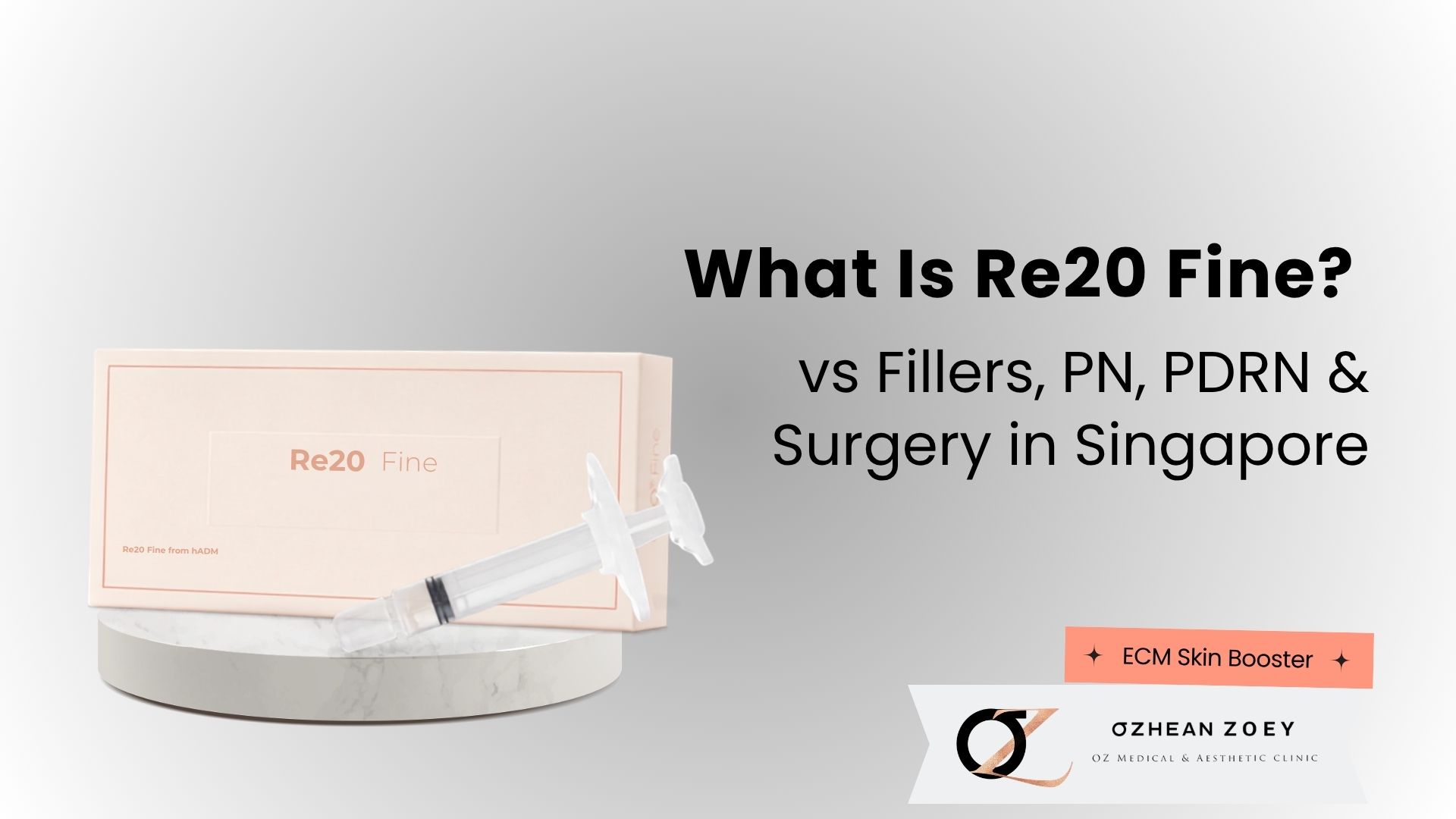
Re20 Fine is a precision ECM skin booster for the under-eyes — here's what it is, how it works, and how it honestly compares to fillers, PN, PDRN and surgery.
The eyes give you away. Not when you're tired — anyone can look tired. The problem is when they give you away even on a morning when you feel perfectly fine: that hollow shadow, the thin, translucent skin, the fine lines that collect overnight and never quite leave. Most people discover through trial and error that this zone resists the usual solutions. Creams reach only the surface. Standard fillers swell, migrate, or create a tell-tale bulge when you smile. And the skin underneath keeps thinning regardless.
Re20 Fine is a different kind of answer — not a filler, not a conventional booster, but a fifth-generation ECM (extracellular matrix) skin booster made from real, human-derived skin scaffold. Its premise is straightforward: instead of propping up the under-eye from the outside, rebuild the structural framework it has lost from within. The concept is new enough that many patients encounter it without context, uncertain how it fits alongside everything else they've tried or been offered.
This guide gives you that context. It explains what Re20 Fine is, how it works, and — most usefully — how it honestly differs from every other way the under-eye is treated: tear-trough fillers, collagen fillers, polynucleotide (PN) boosters, biostimulators, and surgery.
What is Re20 Fine?
Re20 Fine is an injectable ECM (extracellular matrix) skin booster made from human acellular dermal matrix (hADM) — real skin scaffold, processed from donated human skin to remove all living cells, leaving behind the collagen, elastin, proteoglycans and growth factors that form the skin's structural framework. Micronised to an ultra-fine ~50µm particle size specifically for the delicate under-eye zone, it replenishes the skin's own matrix directly — something no HA filler, PN booster or biostimulator does.
The phrase you'll hear associated with it — "injecting real skin into the skin" — is not marketing hyperbole. It describes the mechanism precisely. Rather than hydrating like a hyaluronic acid booster, stimulating like a biostimulator, or repairing like a polynucleotide, Re20 Fine replenishes the scaffold the skin is built on. Think of it this way: if fillers prop up the tent and biostimulators encourage the tent poles to grow taller, Re20 Fine reweaves the canvas itself.
It is classified as a fifth-generation ECM booster, positioned as a distinct treatment category rather than a sub-type of existing injectables. The product volume is 50mg, reconstituted to 1.5–2cc per session, and its primary indications are fine lines around the eyes, under-eye hollowness and dark circles. Results develop gradually over weeks and, following a recommended course, are commonly maintained for around a year or more.
How Re20 Fine works
Re20 Fine doesn't simply deposit material under the skin. It renews the under-eye through three complementary mechanisms.
Scaffold. The human-derived matrix provides a structural template your own cells can migrate into and rebuild upon — physically restoring the framework that thin, aged under-eye skin has lost. Fibroblasts, keratinocytes and stem cells find their footing in the scaffold and resume the collagen-building behaviour that defines youthful skin.
Signal. The matrix acts as a biochemical communicator. It prompts resident fibroblasts to produce fresh collagen and elastin — not because a synthetic chemical has instructed them to, but because they have been returned to the environment in which they naturally function. A 2020 review in Plastic and Aesthetic Research on the ECM's role in skin ageing describes this dynamic clearly: when the matrix degrades, fibroblasts lose their grip, reduce new-matrix production and increase matrix-degrading enzyme activity — a self-perpetuating cycle that ECM replenishment aims to interrupt.
Mechanotransduction. Restored matrix structure allows the skin to translate physical movement into healthy biological response again — the way young, resilient skin does. This is relevant to the under-eye and lips, where constant movement means the tissue needs to remodel rather than resist.
Crucially, this is remodelling, not a foreign-body reaction. Because Re20 Fine is human-derived matrix, the body integrates it through a natural, host-mediated pathway. Preclinical research published in ACS Applied Bio Materials (2025) demonstrated efficient host-tissue integration of a micronised acellular dermal matrix, with fibroblast infiltration, new blood-vessel formation and minimal inflammation — attributed to the removal of cellular DNA and MHC proteins during processing. No synthetic implant is left behind to wall off or encapsulate.
Results are gradual by design. A subtle refreshed appearance may be visible within days. Texture refines over the following 2–4 weeks, and firmness, brightness and dark-circle improvement continue to develop over 6–12 weeks as the skin rebuilds its own collagen. A 2026 human application study documented improvement across multiple skin structural and functional indicators — including density, elasticity, barrier function and hydration — with effects continuing to develop over approximately 20 weeks.
Why the under-eye is so hard to treat
The under-eye is the thinnest skin on the body — often less than half a millimetre. It sits over a complex, mobile anatomy: the orbicularis oculi muscle contracts with every blink, every smile, every squint. Below, a layer of fat that naturally thins with age creates a hollow that deepens across decades. The dermal-epidermal junction flattens; collagen and elastin fragment; the structural matrix that once held everything in place degrades.
A 2025 pilot study quantifying collagen, elastin and glycosaminoglycans across the facial dermis — including specifically the under-eye region — confirmed just how pronounced these structural losses are with age, and how thin and structurally compromised under-eye tissue becomes.
This anatomy is what makes most treatments a compromise here. Swelling is conspicuous in paper-thin skin. Movement exposes any product that doesn't integrate naturally. Particles that work smoothly on the broader face can bump or show as irregularities in a zone this delicate. The under-eye doesn't need a volume prop — it needs structural renewal. That is the gap Re20 Fine is built for.
How Re20 Fine differs from other under-eye treatments
Below is an honest map of the landscape. Each modality has genuine strengths; Re20 Fine is not positioned as a universal replacement. The question is which one — or which combination — addresses what your under-eye has actually lost.
Standard HA (hyaluronic acid) tear-trough fillers
HA fillers produce visible correction in a single session — and that's their strength. The challenge is biology. HA is hydrophilic, so swelling can worsen the morning after. In a high-movement zone, HA gel can migrate, creating irregular bumps; a proportion of patients develop a bluish Tyndall tint through thin skin; and HA adds volume without improving the skin's own quality or thickness.
Re20 Fine integrates as a living matrix rather than a gel deposit, moves with the face, and progressively improves the skin from within. For deeper structural hollow, it works best combined with a low-swelling filler — as in our RE-NEAU™ under-eye protocol.
Collagen fillers
Collagen-based fillers offer a genuine improvement over standard HA: notably less swelling and a more natural smile. The limitation is durability — results fade noticeably from around three months, placing patients in a top-up cycle. Re20 Fine's mechanism is different: results build on the skin's own rebuilding response rather than on the longevity of a deposited material, making the improvement more durable and progressive.
Polynucleotide (PN/PDRN) skin boosters
PN boosters calm, repair and brighten — particularly effective for vascular dark circles, where improved circulation visibly lightens the under-eye tone over time. Their limitation is structural: PN does not restore collapsed scaffold or provide volumising change. Re20 Fine and PN are complementary rather than competing — our enhanced RE-NEAU-EST™ tier layers both, addressing structure, volume and surface brightening together.
Biostimulators (PDLLA/PCL)
Biostimulators prompt the body to generate collagen over time as a synthetic material degrades — effective for broader facial firming, but indirect. They target collagen production alone rather than the full ECM (elastin, glycosaminoglycans and matrix organisation are all part of what ages), and are generally approached with caution in very thin periocular skin where nodule risk is higher.
Re20 Fine directly replenishes the full extracellular matrix at ~50µm — refined for the thinnest facial skin. It doesn't ask the body to build around a foreign scaffold; it delivers the pre-built wall section that the body's own cells then colonise and convert into living tissue.
Surgery (blepharoplasty)
For severely herniated orbital fat — the persistent, firm eye bag that no injectable addresses — surgery remains the most definitive option. The tradeoff is real: weeks of recovery, scarring, and surgeon-dependent outcomes. Over-resection of fat risks irreversible hollowing, one of the hardest aesthetic complications to correct. Re20 Fine is non-surgical and additive: it rebuilds what the skin has lost, not removes what it has too much of. For mild-to-moderate concerns — hollowness, dark circles, crepey skin — it is typically the more appropriate starting point. Our doctors will refer to surgery when that is genuinely the ideal path.
Classic Re20
Re20 Fine and classic Re20 are the same human-derived ECM material in two particle sizes: Fine at ~50µm for the delicate eye area, classic Re20 at approximately 75µm for the broader face and neck. For under-eye treatment, Re20 Fine is the right choice — its ultra-fine grind is what allows it to settle smoothly through paper-thin skin without risk of visible bumps.
| Treatment | What it does | Under-eye limitation | How Re20 Fine differs |
| Standard HA filler | Adds gel volume to tear trough | Swells next day, can migrate & bulge when smiling; Tyndall risk; doesn't improve skin quality | Integrates as living matrix; minimal swelling; moves with face; rebuilds tone |
| Collagen filler | Volumises with less swelling than HA | Results fade noticeably from ~3 months; frequent top-ups needed | Structural rebuilding supports longer retention; improvement continues over weeks |
| PN / PDRN booster | Repairs, brightens, calms; supports circulation | Limited structural or volumising effect; doesn't restore collapsed scaffold | Replenishes the matrix itself; complementary — not a rival (RE-NEAU adds PN tier) |
| Biostimulator (PDLLA/PCL) | Prompts body to make collagen over time | Indirect; targets collagen only; not first-choice for very thin periocular skin | Directly restores full ECM (collagen + elastin + GAGs); 50µm refined for thin skin |
| Surgery (blepharoplasty) | Removes herniated fat / excess skin | Long recovery; scarring; risk of irreversible hollowing; ideal for severe fat herniation | Non-surgical, additive, minimal downtime; suited to mild-to-moderate concerns |
| Classic Re20 | Full-face ECM renewal (≈75µm) | Particles less refined for paper-thin under-eye skin | Re20 Fine ≈50µm: ultra-fine, purpose-built for the eye area |
This table reflects general clinical comparisons. Individual results and suitability vary; a doctor's assessment is required before any treatment.
Who is Re20 Fine suitable for?
Re20 Fine is most suitable for patients whose under-eye concerns are structural: a hollow or sunken tear trough, crepey fine lines, dark circles driven by skin thinness, or mild-to-moderate ageing they'd like to address without surgery. It is also worth considering as a proactive foundation treatment before deeper changes set in, or for patients who've had HA filler that swelled, migrated, or bulged on smiling.
It is not the primary treatment for a large, palpable herniated fat pad — that is a surgical conversation. Our doctors at Ozhean Zoey begin every assessment by understanding what is actually driving your tired eyes, so the plan addresses the right problem rather than applying a default protocol.
The ideal combination: the RE-NEAU™ under-eye protocol
Re20 Fine is the structural layer. For patients who also need volume correction, we pair it with a low-swelling PEG-HA filler in our RE-NEAU™ under-eye protocol: PEG-HA for precise, early-onset correction with minimal swelling; Re20 Fine rebuilding the scaffold beneath and improving tone progressively. The enhanced RE-NEAU-EST™ tier adds a polynucleotide layer for patients with dark circles or fragile skin. The result is a three-depth protocol: structural foundation, volume correction, surface renewal — addressed in a single session.
Is Re20 Fine safe? What to expect
Side effects are generally mild and temporary. The most common are minor redness, small injection-point bumps and slight tenderness at the treatment sites, which typically settle within 24–72 hours. Light bruising is possible depending on your capillary structure but is uncommon. There is no synthetic implant introduced, so the foreign-body reaction associated with some materials is not a concern here — Re20 Fine is processed to remove the cellular components that trigger immune responses, and the body integrates the remaining matrix through a natural remodelling pathway.
The bluish Tyndall tint sometimes seen with under-eye HA is not typically associated with Re20 Fine at appropriate injection depth. Irregularity or unevenness, where it occurs, is largely a technique-dependent outcome — which is exactly why this treatment should be performed by an experienced, registered medical doctor who understands the anatomy of the periocular zone. Topical numbing cream is applied before treatment; most patients describe the experience as mild pressure.
Downtime is minimal. Most patients return to normal activities the same day or the following morning. Avoid strenuous exercise, saunas, steam rooms and alcohol for 24–48 hours post-treatment. Makeup can typically be applied from the following day.
Re20 Fine prices in Singapore (2026)
Under Singapore's HSA medical advertising regulations, aesthetic clinics are not permitted to publicly display specific treatment prices. Cost is confirmed during consultation rather than listed here.
What you pay depends on the areas treated, the volume of product required, and whether Re20 Fine is used on its own or as part of a combination such as the RE-NEAU™ protocol. Rather than comparing numbers, it is worth understanding what the investment covers: a human-derived, tissue-integrating material processed under recognised standards, placed with the anatomical precision that thin under-eye skin demands. Your doctor will provide a personalised, transparent quote during consultation after assessing your skin and goals.
Ready to take the next step?
Re20 Fine is available at Ozhean Zoey Medical & Aesthetic Clinic at TripleOne Somerset, performed by our registered medical doctors. Whether you are exploring Re20 Fine on its own or as part of our RE-NEAU™ under-eye protocol, the right starting point is a proper assessment — because knowing what is actually driving your under-eye concerns is what determines the right plan. Book your consultation here: https://ozheanzoey.com/contact-us/.
Frequently asked questions
Is Re20 Fine a filler or a skin booster?
It is an ECM skin booster — a distinct category. It replenishes the skin's extracellular matrix with human-derived scaffold material rather than adding gel volume. It can be combined with a low-swelling filler for volume plus structural renewal.
Is Re20 Fine more appropriate than filler for dark circles?
It depends on the cause. Structural dark circles — from thinning skin or hollowing — respond well to Re20 Fine. Where volume correction is also needed, combining Re20 Fine with a PEG-HA filler in our RE-NEAU™ protocol gives the more complete outcome.
Does Re20 Fine cause the Tyndall (blue) effect under the eyes?
The bluish Tyndall tint sometimes seen with HA under the eyes is not typically associated with Re20 Fine at appropriate injection depth. It is a technique-dependent phenomenon; an experienced doctor placing product at the correct plane should not produce this effect.
Re20 Fine vs polynucleotide (PN) for under-eyes — which is suitable?
They serve different purposes and work well together. PN repairs, brightens and supports circulation — excellent for vascular dark circles and fragile skin. Re20 Fine restores structural scaffold. Our enhanced RE-NEAU-EST™ tier combines both for patients with complex concerns.
Can Re20 Fine replace under-eye surgery?
For mild-to-moderate concerns — hollowness, dark circles, thinning skin — Re20 Fine is often the suitable non-surgical starting point. For severe herniated fat pads, surgery remains the right assessment; our doctors will always advise honestly on which applies to you.
How long do Re20 Fine results last?
After a recommended course, many patients maintain a firmer, revitalised under-eye for around a year or more. Results build progressively as the skin integrates the matrix; longevity varies with age, skin condition and lifestyle.
How many sessions of Re20 Fine do I need?
Most patients start with a short course of two to three sessions spaced a few weeks apart, then periodic maintenance. Some see good improvement from a single session. Your doctor will personalise the plan at consultation.
Does Re20 Fine hurt?
Most patients find it very tolerable. Numbing cream is applied beforehand, and because the particles are ultra-fine, the material passes through tissue with less resistance than coarser boosters. Many describe Re20 as around 2 out of 10 for discomfort.
Is there downtime with Re20 Fine?
Minimal. Most patients return to work and social activities the same or next day. Minor redness or injection-site bumps typically settle within 24–72 hours. Avoid strenuous exercise, saunas and alcohol for 24–48 hours; makeup from the day after.
Can I combine Re20 Fine with other treatments?
Yes, and it is often recommended. Re20 Fine pairs with PEG-HA filler in our RE-NEAU™ protocol, and complements anti-wrinkle injections, energy-based devices and laser treatments. Because Re20 Fine strengthens the ECM, it can enhance the skin's response to other treatments.
Is Re20 Fine safe, and who performs it?
Re20 Fine has a strong biocompatibility profile as a human-derived, decellularised matrix. It is performed by registered medical doctors at Ozhean Zoey after an individual suitability assessment. Side effects are generally mild and temporary.
The bottom line
Re20 Fine occupies a position no other single modality fills: a human-derived ECM booster refined at 50µm for the most delicate skin on the face, rebuilding structural scaffold rather than only adding hydration, volume or stimulation. For under-eye concerns rooted in structural loss — thinning, hollowing, dark circles, crepey texture — it addresses the foundation rather than the symptom.
The under-eye often presents with layered concerns that respond to layered treatment. Getting the right combination — ECM renewal, volume correction, surface brightening — depends on an accurate assessment of what is actually happening beneath the surface. If you'd like to know what Re20 Fine, or the RE-NEAU™ protocol, could do for your eyes, the first step is a consultation with our medical team at Ozhean Zoey.

About Dr. Park Ji-Youn
Dr. Park Ji-Youn
Dr. Park Ji-Youn is a Korean board-certified dermatologist, founder and director of the Ozhean Skin and Plastic Surgery Network, and Group Medical Director of the Ozhean Group. She has authored over 30 scientific papers on dermatology and created Ozhean’s signature SKIN FIT programme, which has benefitted more than 20,000 patients across Korea, Singapore, and Malaysia. Dr. Park believes in personalised, evidence-based aesthetic treatments that enhance natural beauty — particularly for Asian skin.


