


Ultherapy for Eye Rejuvenation: Can It Reduce Wrinkles and Sagging?
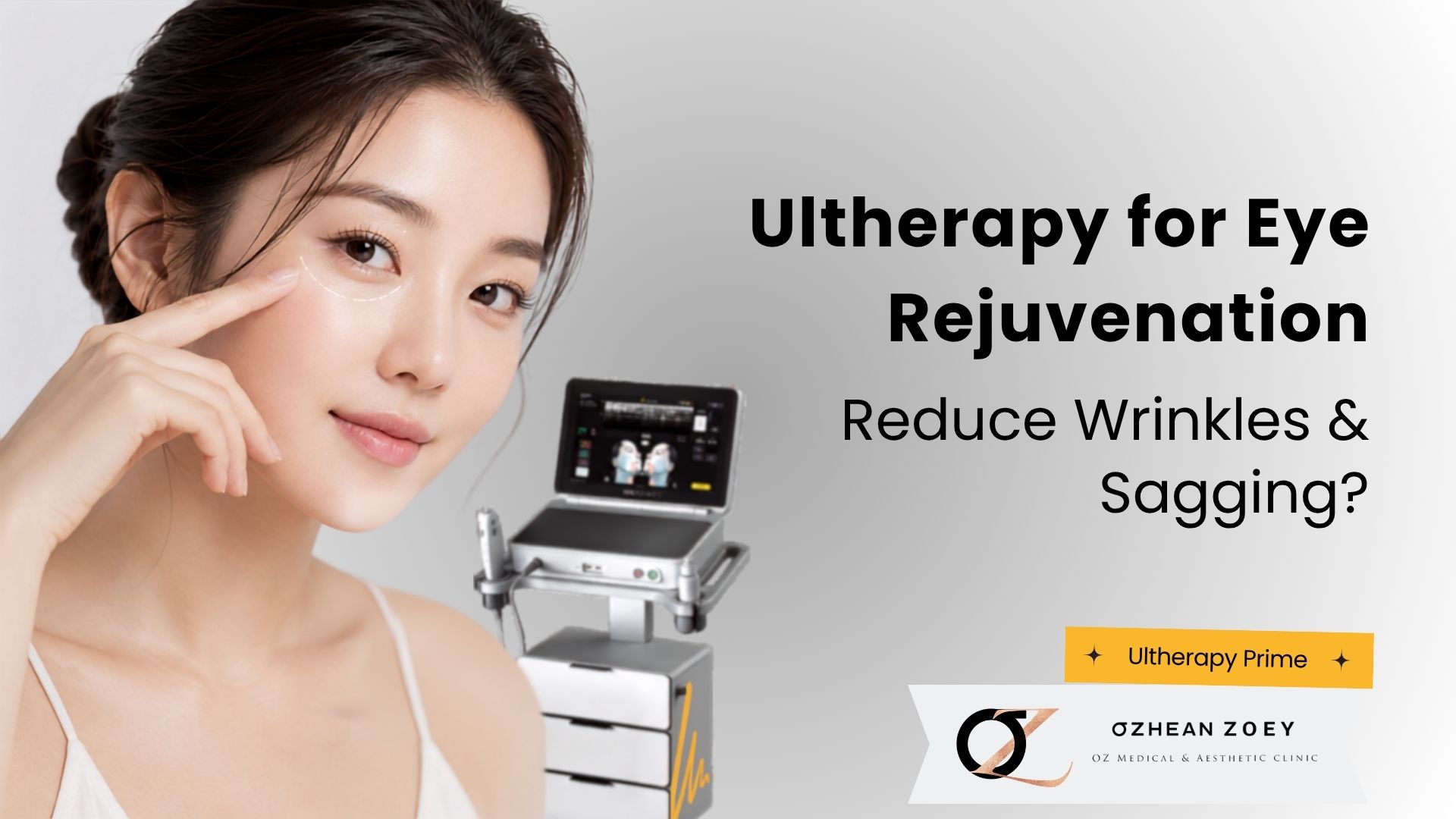
Brow drop, crow’s feet, tired-looking under-eyes — Ultherapy Prime can treat all three, but not with the same transducer, and not always alone. Here is what it can and can’t do.
The eyes are usually the first place ageing shows, and the last place most people think to treat with anything beyond eye cream. A heavier brow, softer upper lid, fanning lines at the outer corner, fine crepiness underneath — none of it is dramatic on its own, but together it is often what makes a face read as tired rather than rested, regardless of how well the rest of the face is ageing.
Ultherapy Prime is frequently recommended for exactly this. It is a genuinely good option for periorbital rejuvenation — but "the eye area" is not one treatment target. It is three different zones with three different tissue problems, and Ultherapy Prime does not treat them the same way.
This guide breaks down what actually happens at each zone, what the evidence says about results, and where the device alone stops being enough.
The eye area is three problems wearing one name
"Eye rejuvenation" collapses three anatomically distinct issues into one phrase: a brow and upper lid that have lost structural support, lateral skin that has developed dynamic wrinkling from decades of expression, and thin under-eye skin showing fine static lines and textural change. Each has a different tissue target, and Ultherapy Prime addresses each with a different transducer.
Zone 1: Upper eyelid and brow
This is a structural problem before it is a skin problem. The brow sits lower than it used to because the ligaments and fascia supporting it — the same superficial musculoaponeurotic system, or SMAS, that a surgical brow lift repositions — have loosened with age. Skin quality on the lid itself is a separate, secondary issue.
This is why two transducers are used together here rather than one. The 4.5 mm or 3.0 mm transducer, depending on tissue thickness, is directed at the SMAS and deeper fat compartments along the brow and temple to re-establish structural lift — the same mechanism that produces measurable brow elevation in the clinical literature. The 1.5 mm transducer is then used more superficially, along the brow and upper lid skin itself, to tighten the thin skin in this area and refine crepiness that structural lifting alone will not resolve. Structure first, surface second — in that order, because lifting a heavy brow before addressing lid skin quality wastes energy on tissue that hasn’t moved into its corrected position yet.
Zone 2: The lateral eye (crow’s feet)
The outer corner of the eye is almost entirely a dermal problem, not a structural one. Decades of squinting and smiling create dynamic wrinkles here well before any meaningful SMAS laxity develops, so this zone is treated with the 1.5 mm transducer alone.
Here is the mechanism in plain terms. The 1.5 mm transducer focuses ultrasound energy just beneath the surface, into the deep dermis, creating a grid of tiny thermal coagulation points — controlled zones of heat roughly a millimetre in size, spaced in a precise pattern. Each point triggers a localised wound-healing response: fibroblasts are recruited to the site, and over the following weeks they lay down new collagen and elastin around it. Multiply that across hundreds of points and the practical effect, three to six months later, is measurably tighter, smoother skin at a depth too shallow for the SMAS transducers to reach and too deep for topical treatments to influence.
Zone 3: Under the eyes
This is the most delicate application of the three, and the one with the narrowest margin for error. Under-eye skin is among the thinnest on the body, sitting directly over orbital fat and close to the orbital bone, so the 1.5 mm transducer is used here at reduced density and lower energy than elsewhere on the face.
The mechanism is the same collagen-stimulation process described above, and it is genuinely useful for fine static lines and mild textural roughness. It is considerably less useful for two things patients commonly hope it will fix: dark circles caused by visible vasculature or pigmentation, which are a colour problem rather than a laxity problem, and true under-eye hollowing from volume loss, which no energy-based device addresses because there is nothing to tighten — the tissue that’s missing needs to be replaced, not contracted.
What the published evidence actually shows
Periorbital rejuvenation with micro-focused ultrasound has a reasonably strong evidence base for a non-invasive treatment, though results are measured in millimetres and percentages of responders, not dramatic transformation.
A 2024 rater-blinded, prospective study of upper facial ultrasound rejuvenation in 40 subjects reported a mean brow elevation of 2.16 mm at 90 days, measured objectively by three-dimensional vector analysis rather than subjective assessment — among the more rigorous datasets available for this specific zone. A 2023 systematic review in the International Journal of Environmental Research and Public Health, pooling 16 eligible studies, found absolute brow lift ranging from 0.47 mm to 1.7 mm, with 92% of patients showing investigator-rated improvement in skin tightening or wrinkle reduction at 90 days that continued for up to a year.
For the lateral and lower eye specifically, a case series using a single high-density session with the 1.5 mm transducer reported visible improvement in periorbital and accordion lines at 180 days, with high patient tolerability and satisfaction — evidence that lines up with what the mechanism above predicts: a slower, more gradual result at this shallower depth, still building at six months rather than peaking immediately.
Two consistent findings across the literature: the upper face responds more robustly and more measurably than the lower eye, and results at every depth continue improving for several months after treatment rather than appearing immediately. Patients expecting a same-week change are usually disappointed; patients checking back at three and six months are usually not.
Who is a good candidate?
The optimal response comes from patients in their thirties to fifties with mild to moderate brow ptosis, early lateral wrinkling, and skin that has not yet developed significant redundancy. If you’re noticing your brow sitting a little lower, faint lines appearing at the outer corner only when you smile, or slightly softer under-eye texture, this is the profile Ultherapy Prime was built for.
It is a poorer fit for two groups. Patients with significant dermatochalasis — heavy, overhanging excess upper eyelid skin that visibly folds or impairs the visual field — have a surgical problem, not an energy-based one; no amount of tightening removes excess skin that is already there. And patients whose primary concern is volume loss (hollow under-eyes, deep tear troughs) are, again, dealing with something missing, not something loose. In both cases, a doctor should say so plainly at consultation rather than proceeding with a treatment that was never going to solve the actual problem.
Side effects around the eyes: what to expect
Redness and mild swelling
The most common response, usually settling within a few hours to a day. The periorbital area, being thinner-skinned, can look slightly more swollen immediately after treatment than other facial zones — this is expected and not a sign of overtreatment.
Bruising
Occasional, particularly along the brow and temple where more superficial vessels sit closer to the treatment path. More common in patients on blood thinners or with a bruising tendency.
Transient numbness or tingling
Rare, and usually resolves on its own within weeks. It occurs when energy is delivered close to a superficial sensory nerve — a real but uncommon risk that careful mapping of the treatment path is specifically designed to avoid, particularly along the temple where the frontal branch of the facial nerve runs close to the surface.
No treatment in this area should ever be performed without a doctor first mapping the orbital rim, bony landmarks and nerve pathways by hand. This is not a zone where a template treatment plan is appropriate.
Our approach at Ozhean Zoey
Zone-specific assessment before a single line is planned
Brow position is measured, not eyeballed. Upper lid skin laxity, lateral wrinkle depth at rest versus in animation, and under-eye skin thickness and fat pad prominence are each assessed separately, because — as above — they call for different transducers, different densities and, in some patients, no treatment at that particular zone at all.
Conservative dosing under the eye
Given how thin this skin is and how close the orbital structures sit, our doctors treat conservatively here by default and add density on a follow-up visit if needed, rather than treating aggressively on the first pass. Under-treating and topping up later is reversible; over-treating this particular zone is not something we consider an acceptable trade for a faster result.
An honest conversation about what won’t change
If dark circles or hollowing are the primary complaint, we say so before treatment rather than after. Ultherapy Prime tightens; it does not lighten pigmentation or replace lost volume, and a doctor who lets a patient believe otherwise is setting up a disappointing three-month review.
Complements well with: monopolar RF and an ECM skin booster
Think of periorbital ageing as three separate layers failing at different rates — like scaffolding, plaster and soil each degrading on their own timeline. Ultherapy Prime is the scaffolding repair: it re-tensions the structural layer. But plaster that has thinned and cracked, and soil that has lost its nutrients, don’t fix themselves once the frame is straight.
Monopolar RF — the plasterwork
Monopolar RF works differently from focused ultrasound: rather than creating discrete coagulation points at a set depth, monopolar RF delivers a broad, uniform field of heating across the dermis, causing an immediate contraction of existing collagen fibres followed by a slower remodelling response over the following weeks. This uniform heating pattern is precisely what makes it well suited to the periorbital area, where skin quality issues — fine crepiness, textural roughness, mild superficial laxity — are spread across the whole lid and lateral zone rather than concentrated at discrete points.
This isn’t a new idea in periorbital medicine. Monopolar RF has one of the longer track records of any energy-based device in this specific area: a multicentre trial using a monopolar RF device on the eyelids reported eyelid tightening and reduced hooding in 71–86% of subjects, with significant improvement on periorbital wrinkle scores. Where Ultherapy Prime re-tensions the structural layer, Monopolar RF smooths and firms the surface sitting on top of it.
Re20 Fine — the soil
Re20 Fine is our finer-gauge formulation of Re20, the human acellular dermal matrix (hADM) skin booster, adapted for delicate, thin-skinned areas like the eyes. Where Ultherapy Prime and Monopolar RF both work by triggering the skin’s own repair response, Re20 Fine works differently: it delivers actual matrix scaffold — the collagen, elastin and structural proteins that make up the extracellular matrix, or ECM — directly into the dermis. Local fibroblasts migrate into this scaffold and begin depositing fresh collagen and elastin onto it over the following three to six months.
This matters specifically for the eye area because periorbital skin is thin to begin with and among the first areas to show ECM depletion — which is a large part of why crepiness and fine lines appear here years before the rest of the face. Rebuilding that foundation is why we consider it a near-essential third layer in a periorbital protocol, not an optional add-on.
The logic of the combination: Ultherapy Prime corrects the structural position. Monopolar RF firms and smooths the surface sitting on that structure. Re20 Fine restores the underlying matrix quality so that structure and surface both hold their result for longer. From our clinical observation across the group, this three-layer combination protocol has produced up to 80% improvement in overall periorbital appearance in appropriately selected patients — a clinic observation, not a published statistic, and one that depends heavily on starting severity and how closely a patient follows the recommended treatment interval.
If you are already considering Ultherapy Prime for a full facelift, treating the eye area in the same session is usually the more efficient path — the brow and temple zones overlap with full-face protocols in any case, and treating them together avoids re-mapping the same tissue twice.
Ready to take the next step?
Tired-looking eyes have more than one cause, and the right treatment depends on which of the three zones — and which underlying tissue problem — is actually driving what you see in the mirror. Our doctors at Ozhean Zoey Medical & Aesthetic Clinic at TripleOne Somerset will assess your brow position, lid skin quality and under-eye tissue separately, tell you honestly which zones will respond to Ultherapy Prime, and where a combination protocol with Monopolar RF or Re20 Fine would take you further.
Book your periorbital assessment here
Frequently asked questions
Can Ultherapy really lift a drooping eyebrow?
Yes, within limits. Clinical studies report an average brow elevation in the range of 0.5–2.2 mm using the deeper transducers on the SMAS layer. That is a real, measurable lift for mild to moderate ptosis — not the several-millimetre repositioning a surgical brow lift achieves for more advanced sagging.
Does Ultherapy work on crow’s feet?
Yes. The 1.5 mm transducer targets the deep dermis at the outer eye, creating thermal coagulation points that stimulate new collagen over three to six months, gradually smoothing dynamic lines at rest. It won’t eliminate lines that only appear during a full smile, since those are driven by underlying muscle movement rather than skin laxity.
Can Ultherapy remove dark circles or eye bags?
No, and any clinic implying otherwise is overselling the device. Dark circles are typically caused by visible blood vessels or pigmentation — a colour issue, not a laxity issue. Eye bags usually involve fat pad prominence or volume loss. Ultherapy Prime tightens skin; it doesn’t change vessel visibility, pigment, or add back lost volume.
Is treatment near the eyes safe?
When performed by a doctor who maps the orbital rim and nerve pathways by hand before treating, yes — this is a well-established application with a long safety record. The main precaution is conservative energy and density under the thin under-eye skin specifically, which is why this is not a zone for a one-size treatment plan.
How many sessions do I need for the eye area?
Most patients see meaningful change from a single, well-planned session addressing all three zones. Patients with more pronounced brow ptosis sometimes benefit from a follow-up session at six months to build on the initial lift.
How soon will I see results around my eyes?
Some immediate tightening is visible, but the meaningful change is collagen-driven and builds gradually. Published data shows continued improvement from 90 days out to a year, so the honest answer is: noticeable at three months, still improving at six.
Is Ultherapy a substitute for blepharoplasty (eyelid surgery)?
Not for everyone. If there is significant excess, overhanging upper eyelid skin, that tissue needs to be surgically removed — no energy-based device tightens away redundant skin that is already there. For mild-to-moderate laxity without true excess, Ultherapy Prime is a genuine non-surgical alternative.
Why combine Ultherapy Prime with Monopolar RF and Re20 Fine rather than doing Ultherapy alone?
Because the three treatments correct three different problems: structural position, surface skin quality, and the underlying ECM foundation those first two sit on. Ultherapy alone addresses only the first. Patients wanting more complete periorbital rejuvenation, rather than lift alone, typically need at least one of the other two layers.
Is Ultherapy painful around the eyes?
The eye area is generally more sensitive than the cheeks or jawline, and patients often describe the brow and temple as the more noticeable zones during treatment. Topical numbing and, for more sensitive patients, additional comfort measures are used routinely to keep this manageable.
How long do results around the eyes last?
In line with results elsewhere on the face, typically twelve to eighteen months before the natural ageing process gradually erodes the improvement. Because periorbital skin is thin and expressive, some patients find maintenance at the closer end of that range keeps results looking consistent.
Can I have Ultherapy on my eyes if I’ve had filler nearby?
Generally yes, with appropriate spacing and technique, and your doctor will factor in any existing filler when planning transducer depth and energy near the tear trough or brow. Always disclose previous filler at consultation so this can be planned around properly.
The bottom line
Ultherapy Prime is a genuinely effective option for periorbital rejuvenation — but only once "the eye area" is broken into what it actually is: a structural brow and lid problem, a dermal lateral-wrinkle problem, and a delicate under-eye problem, each needing a different transducer, different density, and in some cases a different treatment altogether.
Choose a clinic that treats it that way — one that assesses each zone separately, tells you plainly when Ultherapy Prime alone won’t reach your goal, and has an evidence-based combination protocol ready for when it doesn’t. That, more than the device itself, is what determines whether your eyes end up looking rested or simply treated.
References cited
Contini M, Hollander MHJ, Vissink A, Schepers RH, Jansma J, Schortinghuis J. A systematic review of the efficacy of microfocused ultrasound for facial skin tightening. Int J Environ Res Public Health. 2023;20(2):1522.
Randomised, rater-blinded prospective cohort study of micro-focused ultrasound for upper facial skin rejuvenation and brow lift, 40 subjects, 180-day follow-up. PMC11626351, 2024.
Pavicic T et al. Microfocused ultrasound with visualization in skin quality: a narrative review (summarising Lowe et al. periorbital/accordion line case series, single 10-MHz/1.5mm transducer, 180-day follow-up). J Cosmet Dermatol. 2025.
Biesman BS, Baker SS, Carruthers J, Silva HL, Holloman EL. Monopolar radiofrequency treatment of human eyelids: a prospective, multicenter, efficacy trial. Lasers Surg Med. 2006;38(10):890–898.

About Dr. Park Ji-Youn
Dr. Park Ji-Youn
Dr. Park Ji-Youn is a Korean board-certified dermatologist, founder and director of the Ozhean Skin and Plastic Surgery Network, and Group Medical Director of the Ozhean Group. She has authored over 30 scientific papers on dermatology and created Ozhean’s signature SKIN FIT programme, which has benefitted more than 20,000 patients across Korea, Singapore, and Malaysia. Dr. Park believes in personalised, evidence-based aesthetic treatments that enhance natural beauty — particularly for Asian skin.


